
What is "GRESB," a sustainability indicator for the real estate industry?
GRESB, an acronym for Global Real Estate Sustainability Benchmark, is a system for assessing the ESG considerations of real estate companies and funds. It was established in 2009, primarily by a group of major European pension funds that spearheaded the PRI.
GRESB is divided into three assessment systems: "GRESB Real Estate," "GRESB Infrastructure," and "GRESB Real Estate Debt," and the applicable system varies depending on the real estate company or fund.
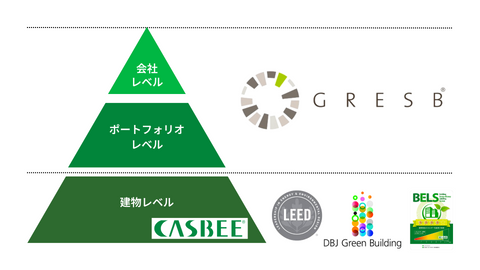
- GRESB is an ESG assessment index at the company and portfolio level.
- CASBEE, LEED, DBJ, GB certification, etc., are comprehensive environmental performance certifications at the building level.
- BELL is a certification specialized in energy-saving performance.
Reasons for GRESB's growing prominence
1. The trend of ESG investing
ESG investing is an investment decision-making process that incorporates environmental, social, and governance factors in addition to traditional financial information. This has become a global trend, and the wave of ESG investing is also accelerating in real estate investment trusts (REITs) and real estate investments.
Real estate inherently possesses significant potential to contribute to solving environmental and social issues. It has been anticipated as a way to address various challenges facing Japan while securing medium- to long-term returns.
In recent years, ESG has become increasingly important for increasing the value and scale of both the J-REIT market and the domestic real estate market, with "green real estate" attracting attention as one example.
2. Green real estate
Green real estate, as its name suggests, refers to properties that are "safe, secure, and environmentally friendly," possessing environmental performance in addition to standard features like earthquake resistance.
The proportion of CO₂ emissions from the construction and real estate sectors is by no means small. As of FY2019, it accounted for approximately 30% of Japan's carbon dioxide emissions, leading to increased attention on real estate with high environmental performance.
Green real estate is evaluated by specialized assessment organizations and certified according to assessment criteria such as CASBEE and BELS.
Consideration for the environment during the design phase and life cycle CO₂ emissions below a certain level are part of the evaluation criteria.
According to data presented by a committee organized by the Ministry of Land, Infrastructure, Transport and Tourism, properties with environmental certifications showed a 4.4% higher new contract rent compared to properties without them. By attracting tenants such as companies that prioritize ESG investing, an increase in property occupancy rates and rents can also be expected.
3. REITs and the decarbonization market
REIT (Real Estate Investment Trust) is an abbreviation for real estate investment trust, also commonly known as "J-REIT." It is said that overseas investors account for approximately 70% of the trading share in the domestic REIT market. As global attention to ESG investing grows, international ESG assessment standards like GRESB are important indicators for overseas investors. This is cited as one reason for driving the decarbonization trend in the domestic REIT market.
Was this article helpful?
What is "GRESB," a sustainability indicator for the real estate industry?
GRESB, an acronym for Global Real Estate Sustainability Benchmark, is a system for assessing the ESG considerations of real estate companies and funds. It was established in 2009, primarily by a group of major European pension funds that spearheaded the PRI.
GRESB is divided into three assessment systems: "GRESB Real Estate," "GRESB Infrastructure," and "GRESB Real Estate Debt," and the applicable system varies depending on the real estate company or fund.
- GRESB is an ESG assessment index at the company and portfolio level.
- CASBEE, LEED, DBJ, GB certification, etc., are comprehensive environmental performance certifications at the building level.
- BELL is a certification specialized in energy-saving performance.
Reasons for GRESB's growing prominence
1. The trend of ESG investing
ESG investing is an investment decision-making process that incorporates environmental, social, and governance factors in addition to traditional financial information. This has become a global trend, and the wave of ESG investing is also accelerating in real estate investment trusts (REITs) and real estate investments.
Real estate inherently possesses significant potential to contribute to solving environmental and social issues. It has been anticipated as a way to address various challenges facing Japan while securing medium- to long-term returns.
In recent years, ESG has become increasingly important for increasing the value and scale of both the J-REIT market and the domestic real estate market, with "green real estate" attracting attention as one example.
2. Green real estate
Green real estate, as its name suggests, refers to properties that are "safe, secure, and environmentally friendly," possessing environmental performance in addition to standard features like earthquake resistance.
The proportion of CO₂ emissions from the construction and real estate sectors is by no means small. As of FY2019, it accounted for approximately 30% of Japan's carbon dioxide emissions, leading to increased attention on real estate with high environmental performance.
Green real estate is evaluated by specialized assessment organizations and certified according to assessment criteria such as CASBEE and BELS.
Consideration for the environment during the design phase and life cycle CO₂ emissions below a certain level are part of the evaluation criteria.
According to data presented by a committee organized by the Ministry of Land, Infrastructure, Transport and Tourism, properties with environmental certifications showed a 4.4% higher new contract rent compared to properties without them. By attracting tenants such as companies that prioritize ESG investing, an increase in property occupancy rates and rents can also be expected.
3. REITs and the decarbonization market
REIT (Real Estate Investment Trust) is an abbreviation for real estate investment trust, also commonly known as "J-REIT." It is said that overseas investors account for approximately 70% of the trading share in the domestic REIT market. As global attention to ESG investing grows, international ESG assessment standards like GRESB are important indicators for overseas investors. This is cited as one reason for driving the decarbonization trend in the domestic REIT market.